GUANGZHOU, GUANGDONG, CHINA, October 9, 2026 /EINPresswire.com/ — Why Buffer Tanks Are No Longer Optional in Commercial Heat Pump Projects
The global push toward electrification and decarbonization has transformed the commercial heating landscape. Heat pumps are now the default specification for hotels, hospitals, residential developments, and industrial facilities. As heat pump capacities grow, a critical system component is increasingly determining whether these projects succeed or fail: the buffer tank.
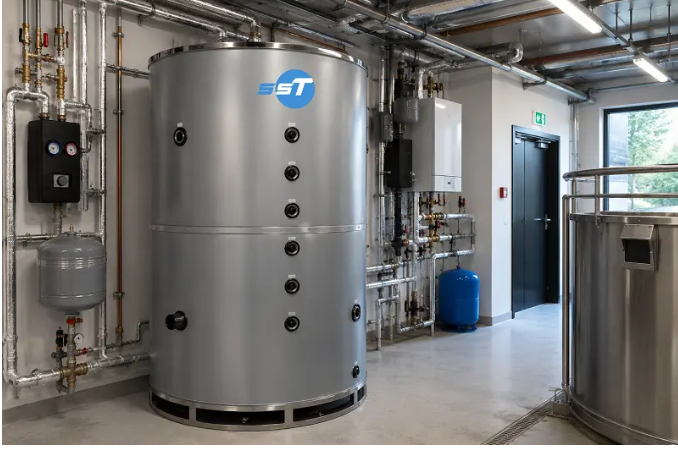
A buffer tank is not a passive water container. It is the thermal flywheel that absorbs the mismatch between heat pump output and building demand, prevents compressor short-cycling, and enables load staging across multiple heat sources.
Stainless Steel vs. Enamel: Why the Material Choice Determines System Longevity
Commercial buffer tanks are manufactured in two primary material constructions: stainless steel and vitreous enamel (glass-lined) carbon steel. Their behavior under real commercial operating conditions differs dramatically.
⚠️ The Thermal Cycling Problem in Enamel Tanks
Enamel tanks rely on a glass-based coating bonded to carbon steel. Due to thermal expansion mismatch, thousands of cycles cause the enamel to craze, crack, or delaminate. Once compromised, internal corrosion and magnetite sludge generation occur, which circulates through the entire system, degrading efficiency and causing costly maintenance.
The Stainless Steel Alternative: Engineered for Cyclic Service
Stainless steel buffer tanks require no internal coating, meaning no delamination risk and no sacrificial anodes. This ensures system water stays clean, reducing maintenance costs by 40–60% over a 20-year lifecycle.
Five Engineering Advantages of Stainless Steel Buffer Tanks
Superior Efficiency Through Better Stratification:
A key performance metric for any buffer tank is its thermal stratification capability—the ability to maintain distinct temperature layers rather than mixing the entire volume. Stratified tanks allow the heat pump to draw the coldest return water from the bottom while supplying hot water to the system from the top, maximizing heat pump COP.
Research indicates that stratified 4-pipe buffer tanks outperform mixed 2-pipe designs by 5–10% in system efficiency. Stainless steel’s smooth, non-porous internal surface facilitates better natural stratification than rough or coated surfaces, while also resisting the biofilm buildup that can disturb thermal layering over time.
High Pressure and Temperature Ratings:
Commercial heat pump systems frequently operate at 6–10 bar working pressure, and modern high-temperature heat pumps (R290, CO₂, and cascade systems) can deliver flow temperatures of 70–90°C. These conditions fall under strict pressure vessel regulations such as the EU PED (Pressure Equipment Directive).
Stainless steel vessels handle these mixed conditions—simultaneous connection to heat pumps, solar thermal arrays, backup boilers, and CHP units—with full pressure vessel certification and third-party inspection available. Enamel tanks, by contrast, face increased risk of coating failure at sustained elevated temperatures, making them less reliable for high-temperature commercial applications.
Thermal Energy Storage and Load Shifting:
Modern commercial buildings are increasingly deploying thermal energy storage (TES) as a demand-side management strategy. Buffer tanks serve as the storage medium, allowing the building to:
Shift heating loads from peak tariff periods to off-peak hours
Absorb surplus heat from heat pump overproduction during mild weather
Provide emergency thermal backup when the primary heat source is offline
Modular Parallel Configuration:
For installations exceeding 1,000 litres of required buffer volume, multiple stainless steel tanks piped in parallel offer significant advantages over a single large vessel:
Built-in redundancy: One tank can be isolated for maintenance without shutting down the entire system.
Staged capacity: Tanks can be brought online incrementally as building occupancy or load grows.
Logistics-friendly: Smaller tanks fit through standard doorways and elevators, avoiding costly rigging and structural modifications.
Better stratification: Multiple smaller tanks maintain better thermal layering than one very large vessel.
SST Heating Energy Co., Ltd: Engineering the Buffer Tanks That Commercial Systems Demand
SST is the No.1 duplex stainless water tank and butt-welding production technology producer in China. Their butt-welded construction eliminates crevice corrosion sites, ensuring leak-free performance.
Custom Engineering Options:
Custom nozzle positions, sizes, and flange ratings.
Multiple internal heating coils for different heat sources.
Integrated electric backup heaters from 3kW to 90kW.
Horizontal or vertical configurations.
SST’s quality is validated by global industry leaders including BOSCH, DAIKIN, HITACHI, Rinnai, LG, MIDEA, HAIER, HISENSE, and Panasonic.
Making the Specification Decision: The market is moving toward stainless steel. For projects involving cascaded heat pump arrays or variable load profiles, stainless steel buffer tanks are the engineered choice that protects the entire system investment.
Contact SST Heating Energy Co., Ltd to discuss your system requirements.
SST Heating Energy Co., Ltd.
SST Heating Energy Co., Ltd.
Legal Disclaimer:
EIN Presswire provides this news content “as is” without warranty of any kind. We do not accept any responsibility or liability
for the accuracy, content, images, videos, licenses, completeness, legality, or reliability of the information contained in this
article. If you have any complaints or copyright issues related to this article, kindly contact the author above.

Media gallery