LIANYUNGANG, JIANGSU, CHINA, August 26, 2026 /EINPresswire.com/ — How do engineers prevent micro-cracks and residual stress when light paths and reaction gases need to turn sharp corners inside high-temperature processing equipment? When optical laser cavities and diffusion furnace exhaust lines require curved quartz components, selecting the right manufacturing method often determines whether the component survives months of continuous thermal cycling.
High-purity fused quartz glass serves as an indispensable material across photovoltaic manufacturing, semiconductor processing, optical laboratories, and chemical synthesis equipment. Because fused silica features an exceptionally low coefficient of thermal expansion, high light transmittance, and thermal stability up to 1200℃, forming it into non-linear or bent shapes poses unique physical challenges. Modern industrial applications often rely on a professional precision quartz glass bending service from specialized fabricators like Lianyungang Southeast Quartz Products Co., Ltd. to craft bent quartz tubes, elbow connectors, folded observation windows, and curved reflection plates without sacrificing material purity or mechanical integrity. When designing custom glass components, understanding the operational differences between hot thermal bending and cold mechanical processing helps engineering teams mitigate optical distortion and premature equipment failure.
Understanding the Hidden Stress in Bent Quartz Components
In high-precision optical and high-temperature gas delivery systems, bent quartz tubes and curved plates redirect laser beams, contain reactive plasma, or channel corrosive chemicals. However, bending a rigid, brittle material inevitably alters its internal physical properties. Engineers evaluating curved quartz components typically face a critical trade-off between optical stress management and atmospheric leak integrity.
Cold processing methods rely on traditional mechanical techniques such as CNC cutting, drilling, slotted milling, and subsequent optical adhesive bonding. To construct a 90-degree turn or a angled window, technicians cut flat fused quartz plates or straight quartz tubes at precise angles, machine mating slots, and join the pieces together using specialized polymer adhesives or glass frits. While cold machining yields tight dimensional tolerances for simple geometries, the joint interfaces present inherent micro-fractures, optical discontinuity, and organic resin adhesives that degrade under elevated temperatures or ultraviolet exposure. The physical joint introduces stress concentrations and unwanted double refraction (birefringence), which disrupts polarized light in laser cavities and creates potential leak paths under vacuum conditions.
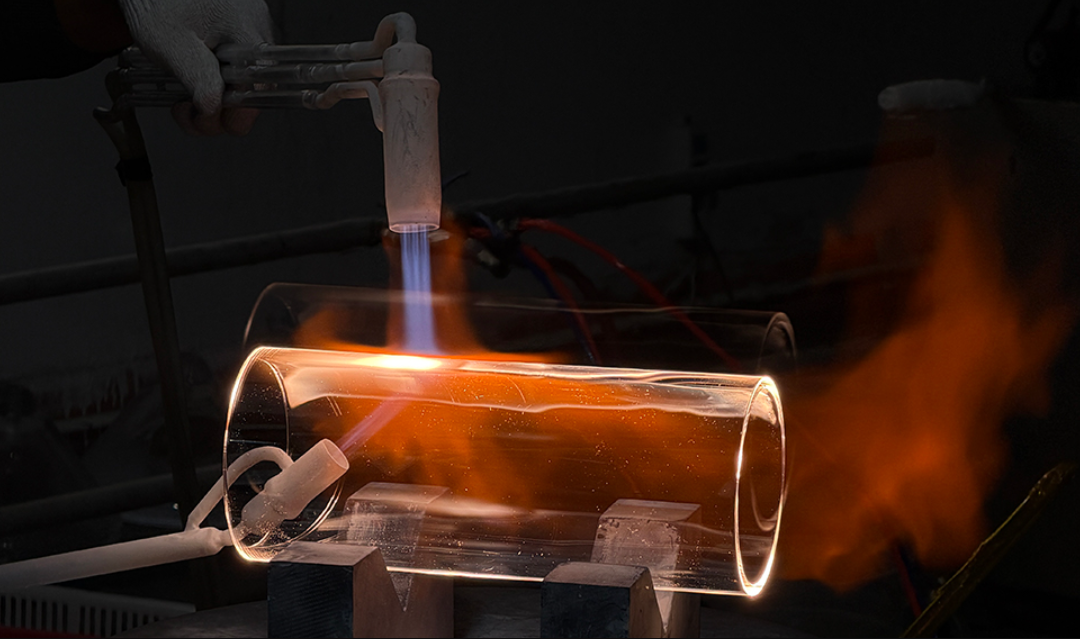
Conversely, thermal hot bending reshapes the continuous quartz tube or quartz plate by manipulating its viscosity window. By elevating high-purity fused quartz raw materials to a softening state using localized oxy-hydrogen gas flames, technicians form curved geometries directly from a single continuous piece of glass. This hot thermal method preserves material continuity along the flow path or light channel, eliminating structural joints, adhesive contamination, and gas leakage risks.
Thermal Hot Bending Mechanics and Stress Mitigation
Executing a professional precision quartz glass bending service requires precise heat management and careful handling during the softening phase. High-purity fused quartz possesses a high softening temperature, requiring localized heating around 1700℃ using precise oxy-hydrogen burner heads. At this elevated temperature, the quartz transitions into a viscoelastic state, allowing skilled technicians or automated fixtures to bend the material to specified angles or bend radii without collapsing the inner diameter of hollow tubes or creating surface wrinkling.
The thermal hot bending workflow relies heavily on controlled post-forming thermal treatment. Heating quartz unevenly creates localized thermal gradients that trap intense stress within the silica matrix upon rapid cooling. To eliminate these residual stresses, the bent quartz components pass through an annealing furnace where controlled heating and gradual cooling cycles relax the molecular network.
This post-forming annealing process transforms how residual stress behaves over the lifecycle of the component. Hot thermal bending incorporates stress management directly into a documentable, repeatable annealing temperature curve. Thermal annealing converts internal forces into a stable state before the component enters service. In contrast, cold-machined and bonded assemblies transfer physical stresses outward to the adhesive layer, assembly fasteners, and mating flanges. When subjected to continuous thermal shock and pressure fluctuations in industrial furnaces, cold-bonded joints risk sudden delamination, outgassing, and mechanical failure.
Engineering Tailored Quartz Solutions for Industrial Demand
Custom glass fabrication requires strict adherence to technical specifications, drawing tolerances, and application-specific parameters. Relying on advanced processing equipment, Lianyungang Southeast Quartz Products Co., Ltd. delivers customized quartz glass components engineered for demanding working conditions, including high-vacuum environments, high-temperature sintering, and precision laboratory experiments.
Working directly from technical customer drawings, Southeast Quartz fabricates specialized quartz items by matching specific bending angles, bend radii, wall thickness tolerances, and customized end-flange connections. For complex quartz instruments, quartz bell jars, diffusion furnace tubes, quartz boats, and tri-acid purification systems, maintaining precise spatial alignment ensures seamless integration into existing equipment layouts.
To maintain strict quality control, Lianyungang Southeast Quartz Products Co., Ltd. conducts comprehensive inspection routines across every batch of bent quartz components. Finished products undergo dimensional re-measurement, optical surface inspections, and pressure testing. By pairing full-process production capabilities—spanning from raw quartz material selection to final CNC precision machining, thermal bending, polishing, and hermetic sealing—Southeast Quartz supplies traceably annealed components accompanied by precise dimensional inspection reports.
Choosing the Right Bending Partner for Critical Systems
Selecting between hot thermal bending and cold mechanical fabrication ultimately comes down to determining where residual stress should reside throughout the operational life of a component. Choosing a professional precision quartz glass bending service delegates stress management to a controlled factory thermal annealing process, ensuring the delivered component remains structurally sound, optically uniform, and gas-tight.
For high-temperature processing, chemical distillation, and optical reflection systems, hot thermal bending provides superior long-term reliability by eliminating organic adhesives and joint interfaces. By leveraging abundant local high-quality quartz resources, standardized production workshops, and experienced technical teams, Lianyungang Southeast Quartz Products Co., Ltd. delivers durable, high-purity quartz consumables tailored to exact customer drawings. Discovering how tailored quartz components enhance process stability starts with analyzing design requirements and partnering with an experienced glass fabrication manufacturer.
To explore custom quartz glass manufacturing services, product catalogs, and engineering capabilities, please visit https://www.dnquartz.com/
Lianyungang Southeast Quartz Products Co.,Ltd.
Lianyungang Southeast Quartz Products Co.,Ltd.
+ +86 135 8528 6180
email us here
Legal Disclaimer:
EIN Presswire provides this news content “as is” without warranty of any kind. We do not accept any responsibility or liability
for the accuracy, content, images, videos, licenses, completeness, legality, or reliability of the information contained in this
article. If you have any complaints or copyright issues related to this article, kindly contact the author above.

Media gallery