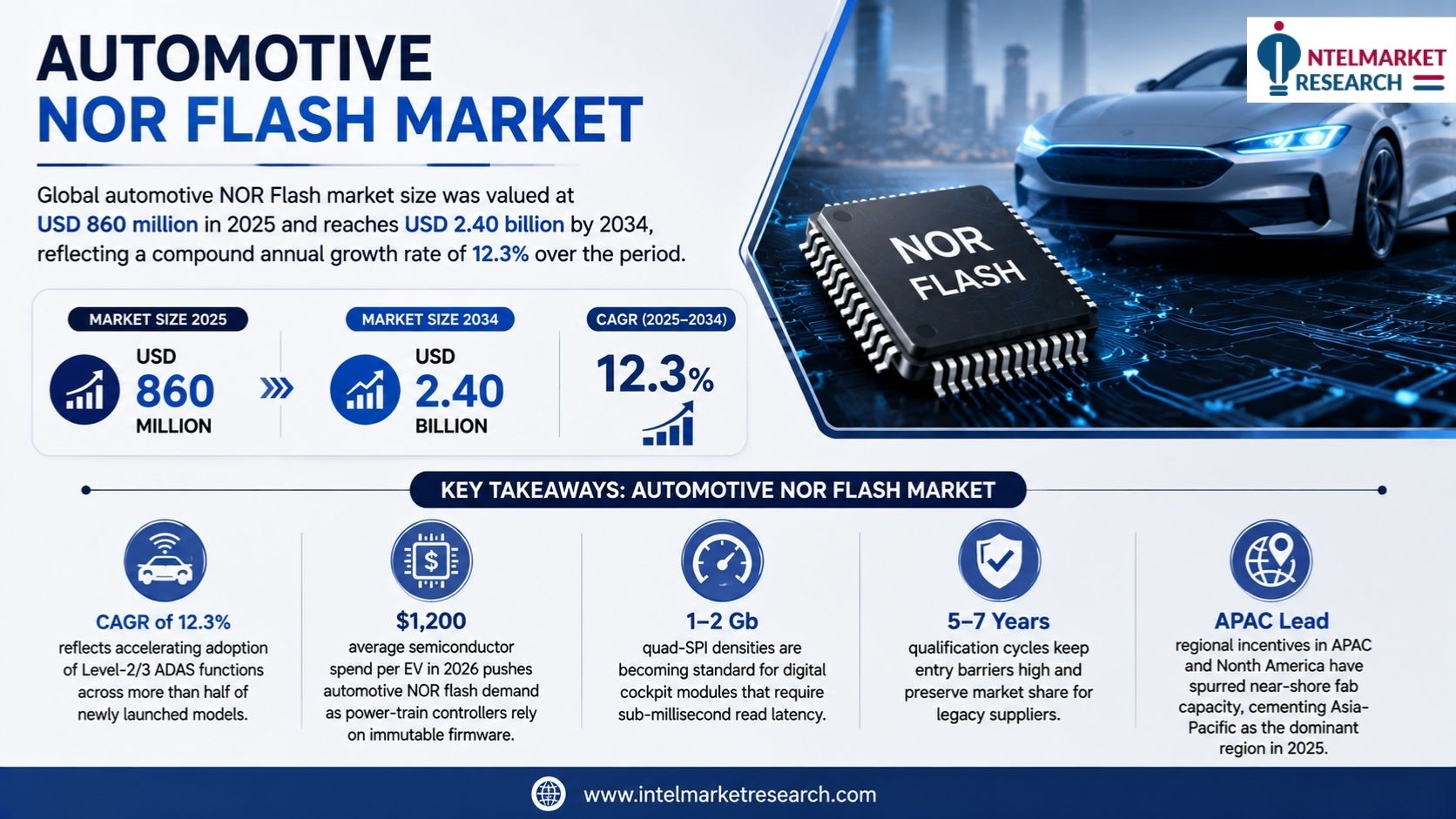
Automotive NOR Flash Market to reach USD 2.40 Bn by 2034 from USD 860 Mn in 2025, driven by software-defined vehicles & rising electronics demand at 12.3% CAGR
PUNE, MAHARASHTRA, INDIA, August 24, 2026 /EINPresswire.com/ — Automotive NOR Flash Market is evolving from a traditional role as a trusted boot-code storage device. Automakers are changing how they view embedded memory by 2026 with the move to software-defined vehicles, centralized computing, zonal electrical architectures and AI-enabled cockpits.
The transition is important as functionality of vehicles is more and more defined by software and not by fixed hardware. The International Energy Agency (IEA) states that automotive architectures are moving away from distributed electronic control units to domain and zonal architectures, facilitating wider software updates, increased functionality and centralized computing.
This is a different competitive landscape for NOR Flash vendors. Automotive customers are looking for more than density and endurance. They demand fast boot performance, functional safety, cybersecurity, long qualification lifecycles and compatibility with next-generation automotive processors.
𝐓𝐡𝐞 𝐍𝐞𝐰 𝐃𝐞𝐦𝐚𝐧𝐝 𝐒𝐢𝐠𝐧𝐚𝐥: 𝐌𝐨𝐫𝐞 𝐒𝐨𝐟𝐭𝐰𝐚𝐫𝐞, 𝐌𝐨𝐫𝐞 𝐁𝐨𝐨𝐭-𝐂𝐫𝐢𝐭𝐢𝐜𝐚𝐥 𝐂𝐨𝐝𝐞
o Modern vehicles are growing much larger software footprints as ADAS, digital cockpits, connectivity, telematics and vehicle-control functions expand.
o This is generating more demand for NOR Flash in applications where the code has to be available immediately and reliably after power-up.
o Instrument clusters, gateways, infotainment platforms, telematics systems, ADAS controllers and other electronic modules may need non-volatile memory for firmware, secure boot processes and software-update functions.
o The architectural shift is significant because a vehicle with fewer, but more powerful, controllers places a greater burden on individual computing platforms.
o McKinsey also pointed to the need for sufficient memory and storage as AI and advanced ADAS workloads increase, with centralized and zonal architectures key enablers for software-defined vehicles.
🔸𝗬𝗼𝘂 𝗰𝗮𝗻 𝗳𝗿𝗲𝗲𝗹𝘆 𝗯𝗿𝗼𝘄𝘀𝗲 𝗼𝘂𝗿 𝗺𝗼𝘀𝘁 𝗿𝗲𝗰𝗲𝗻𝘁 𝘂𝗽𝗱𝗮𝘁𝗲𝗱 𝗿𝗲𝗽𝗼𝗿𝘁 𝘁𝗼 𝗹𝗲𝗮𝗿𝗻 𝗺𝗼𝗿𝗲 𝗯𝗲𝗳𝗼𝗿𝗲 𝘀𝗰𝗿𝗼𝗹𝗹𝗶𝗻𝗴 𝗳𝘂𝗿𝘁𝗵𝗲𝗿: https://www.intelmarketresearch.com/automotive-nor-flash-market-5049
𝟐𝟎𝟐𝟔 𝐒𝐩𝐨𝐭𝐥𝐢𝐠𝐡𝐭: 𝐀𝐮𝐭𝐨𝐦𝐨𝐭𝐢𝐯𝐞 𝐍𝐎𝐑 𝐅𝐥𝐚𝐬𝐡 𝐌𝐨𝐯𝐞𝐬 𝐢𝐧𝐭𝐨 𝐀𝐈 𝐂𝐨𝐜𝐤𝐩𝐢𝐭𝐬
One of the most obvious recent developments is the qualification of automotive NOR Flash for next generation AI-enabled cockpit platforms.
➢ 𝗜𝗻 𝗔𝘂𝗴𝘂𝘀𝘁 𝟮𝟬𝟮𝟲 Infineon announced that MediaTek has qualified its 512 Mb Quad SPI NOR Flash for the Dimensity Auto Cockpit C-X1 platform. This development demonstrates the way NOR Flash is carving its role in the overall architecture that underlies advanced in-vehicle computing and smart cockpit systems.
This is commercially important to memory suppliers as cockpit platforms are becoming increasingly software intensive. Reliable firmware storage and fast system initialization become more important with the addition of AI assistants, connected infotainment, richer graphical interfaces and continuous software improvements.
So the opportunity is bigger than traditional instrument clusters. NOR Flash is becoming more and more embedded throughout the software infrastructure that enables vehicles to power up, upgrade, authenticate, and run critical electronic systems.
𝐒𝐞𝐠𝐦𝐞𝐧𝐭𝐚𝐭𝐢𝐨𝐧 𝐈𝐧𝐬𝐢𝐠𝐡𝐭𝐬:
𝐁𝐲 𝐃𝐞𝐧𝐬𝐢𝐭𝐲
• Below 128 Mb
• 128 Mb to 512 Mb
• 1 Gb to 2 Gb
• Above 2 Gb
128 Mb to 512 Mb remains a major segment as it supports a broad range of automotive firmware and embedded-code requirements;
𝐁𝐲 𝐈𝐧𝐭𝐞𝐫𝐟𝐚𝐜𝐞
• SPI NOR
• Quad SPI NOR
• Octal SPI NOR
• xSPI NOR
Octal SPI NOR is gaining momentum as automotive computing platforms demand faster memory access;
𝐁𝐲 𝐕𝐞𝐡𝐢𝐜𝐥𝐞 𝐓𝐲𝐩𝐞
• Passenger Cars
• Commercial Vehicles
• Electric Vehicles
• Hybrid Vehicles
• Heavy-Duty Vehicles
Passenger Cars account for a significant share of demand as software-defined features become increasingly common;
𝐁𝐲 𝐀𝐩𝐩𝐥𝐢𝐜𝐚𝐭𝐢𝐨𝐧
• Advanced Driver Assistance Systems
• Digital Cockpit & Infotainment
• Instrument Clusters
• Telematics & Connectivity
• Body Electronics
• Powertrain & Vehicle Control
• Gateway & Zonal Controllers
Digital Cockpit & Infotainment is emerging as a high-value application as vehicles adopt AI-enabled interfaces and richer software environments;
𝐁𝐲 𝐒𝐚𝐟𝐞𝐭𝐲 & 𝐒𝐞𝐜𝐮𝐫𝐢𝐭𝐲 𝐋𝐞𝐯𝐞𝐥
• Standard Automotive Grade
• ASIL-B
• ASIL-C
• ASIL-D
• Cybersecurity-Enhanced NOR Flash
ASIL-D NOR Flash are gaining importance in safety-critical vehicle architectures;
𝗕𝘆 𝗠𝗲𝗺𝗼𝗿𝘆 𝗔𝗿𝗰𝗵𝗶𝘁𝗲𝗰𝘁𝘂𝗿𝗲
• Conventional Serial NOR
• Multi-I/O NOR
• Secure NOR Flash
• ECC-Enabled NOR Flash
• High-Density NOR Flash
Secure NOR flash is increasingly prioritized for next-generation automotive platforms.
🔸𝐀𝐜𝐜𝐞𝐬𝐬 𝐭𝐡𝐞 𝐋𝐚𝐭𝐞𝐬𝐭 𝐈𝐧𝐬𝐢𝐠𝐡𝐭𝐬 𝐟𝐫𝐨𝐦 𝐎𝐮𝐫 𝐋𝐚𝐭𝐞𝐬𝐭 𝐒𝐚𝐦𝐩𝐥𝐞 𝐒𝐭𝐮𝐝𝐲: https://www.intelmarketresearch.com/download-free-sample/5049/automotive-nor-flash-market
𝐒𝐞𝐜𝐮𝐫𝐢𝐭𝐲 𝐈𝐬 𝐁𝐞𝐜𝐨𝐦𝐢𝐧𝐠 𝐚 𝐏𝐮𝐫𝐜𝐡𝐚𝐬𝐞 𝐂𝐫𝐢𝐭𝐞𝐫𝐢𝐨𝐧, 𝐍𝐨𝐭 𝐚𝐧 𝐀𝐝𝐝-𝐎𝐧
Automotive cybersecurity is also changing the specification process for non-volatile memory.
As vehicles receive software updates throughout their operating lives, protecting firmware against unauthorized modification becomes essential. Secure boot, authentication, data integrity and hardware-level security features are becoming increasingly relevant to memory selection.
A notable 2026 example came from Macronix, which announced that it’s MX78 ArmorFlash automotive NOR Flash family had been developed under the ISO/SAE 21434 cybersecurity process and was compliant with ISO 26262 ASIL D functional-safety requirements.
This points toward a broader market trend: automotive NOR Flash suppliers are competing not only on memory specifications but also on the ability to support safety and cybersecurity requirements throughout the vehicle development cycle.
𝐖𝐡𝐲 𝐱𝐒𝐏𝐈 𝐚𝐧𝐝 𝐇𝐢𝐠𝐡-𝐒𝐩𝐞𝐞𝐝 𝐈𝐧𝐭𝐞𝐫𝐟𝐚𝐜𝐞𝐬 𝐌𝐚𝐭𝐭𝐞𝐫?
– Interface performance is also driving the next wave of demand for Automotive NOR Flash.
With automotive processors getting more powerful, traditional memory interfaces can become a bottleneck in boot and firmware access. Higher bandwidth is provided by high-speed Serial NOR technologies, such as Quad SPI and Octal or xSPI architectures, while maintaining the non-volatile characteristics required for embedded code storage.
This is especially important for software-defined vehicles where fast start-up, secure firmware validation and frequent software updates are becoming increasingly important.
So the market opportunity is moving toward higher value memory configurations, not just higher unit volumes.
Have a Look for Insightful Geographical Analysis
🔹𝐍𝐨𝐫𝐭𝐡 𝐀𝐦𝐞𝐫𝐢𝐜𝐚
North America remains a technologically advanced Automotive NOR Flash market, supported by strong demand for connected vehicles, ADAS, premium digital cockpits and software-defined vehicle platforms.
•U.S. auto makers are putting big money into centralized vehicle computing and advanced electronic architectures.
•Demand for secure automotive memory is increasing with rising cybersecurity requirements.
•Increasing adoption of over-the-air (OTA) software updates is driving demand for reliable firmware storage.
•The demand for high-performance memory is driven by EV and autonomous-driving development.
🔹𝐄𝐮𝐫𝐨𝐩𝐞
Europe remains a major market because of its concentration of premium automakers, automotive semiconductor suppliers and stringent functional-safety requirements.
•Germany is a major demand center given its automotive manufacturing ecosystem.
•More and more EU OEMs are switching to zonal and centralized E/E architectures.
•Increased focus on vehicle cyber security and functional safety to enable higher-value NOR Flash solutions.
•Advanced infotainment, ADAS and software defined features are increasingly found in premium vehicles.
🔹𝐀𝐬𝐢𝐚 𝐏𝐚𝐜𝐢𝐟𝐢𝐜
Asia Pacific is expected to remain the leading regional growth engine, driven by China’s expanding EV industry, high vehicle production volumes and rapid adoption of intelligent vehicle technologies.
•China is moving faster on software-defined EV platforms and intelligent cockpits.
•Strong positions for Japan and South Korea in automotive semiconductors and memory technologies.
•Increasing EV production is increasing the semiconductor content per vehicle.
•Regional OEMs are fast adopting ADAS, connectivity, digital cockpits and centralized computing.
•Increased automotive semiconductor manufacturing capacity enhances local supply-chain capabilities.
🔹𝐋𝐚𝐭𝐢𝐧 𝐀𝐦𝐞𝐫𝐢𝐜𝐚
Latin America represents an emerging opportunity as vehicle production, automotive electronics penetration and connected-vehicle adoption increase.
•Brazil and Mexico continue to play an important automotive manufacturing role.
•Higher electronics content in locally produced vehicles supports demand for automotive-grade memory
•Growing adoption of ADAS and connected infotainment is creating new application opportunities.
•Growing availability of EV and hybrid vehicles is likely to drive demand over the longer term.
🔹𝐌𝐢𝐝𝐝𝐥𝐞 𝐄𝐚𝐬𝐭 & 𝐀𝐟𝐫𝐢𝐜𝐚
The Middle East & Africa market is developing as connected mobility, premium vehicles and advanced automotive electronics gain traction.
•Premium and luxury vehicles are supporting demand for sophisticated cockpit and connectivity systems.
•Growing investments in smart mobility infrastructure are encouraging connected-vehicle adoption.
•Increasing vehicle digitization is creating opportunities for automotive semiconductor suppliers.
•EV adoption in Gulf markets is expected to gradually expand the addressable market for advanced automotive memory.
𝐙𝐨𝐧𝐚𝐥 𝐀𝐫𝐜𝐡𝐢𝐭𝐞𝐜𝐭𝐮𝐫𝐞 𝐈𝐬 𝐑𝐞𝐰𝐫𝐢𝐭𝐢𝐧𝐠 𝐭𝐡𝐞 𝐌𝐞𝐦𝐨𝐫𝐲 𝐌𝐚𝐩
One of the biggest structural drivers for automotive memory demand could be the shift to zonal vehicle architecture.
Instead of assigning separate electronic control units to many individual functions, zonal architectures consolidate processing and link vehicle functions via localized controllers and high-speed networks. SAE research published in 2026 points to the industry’s move to zonal configurations but says central compute platforms, zonal controllers, automotive Ethernet and standardized software architectures are still in development.
For memory vendors this presents an opportunity to be involved in the redesign of vehicle electronics, rather than just the provision of replacement components for legacy ECUs.
The question for OEMs is increasingly not “How much Flash does one ECU need?” but “Where should persistent software live across the vehicle architecture?”
𝐖𝐡𝐚𝐭 𝐀𝐮𝐭𝐨𝐦𝐨𝐭𝐢𝐯𝐞 𝐁𝐮𝐲𝐞𝐫𝐬 𝐀𝐫𝐞 𝐖𝐚𝐭𝐜𝐡𝐢𝐧𝐠 𝐢𝐧 𝟐𝟎𝟐𝟔?
For OEMs and Tier-1 suppliers, the Automotive NOR Flash procurement equation is changing rapidly.
𝗞𝗲𝘆 𝗲𝘃𝗮𝗹𝘂𝗮𝘁𝗶𝗼𝗻 𝗰𝗿𝗶𝘁𝗲𝗿𝗶𝗮 𝗻𝗼𝘄 𝗶𝗻𝗰𝗹𝘂𝗱𝗲:
• 𝗙𝘂𝗻𝗰𝘁𝗶𝗼𝗻𝗮𝗹 𝘀𝗮𝗳𝗲𝘁𝘆: ASIL capability and automotive qualification are becoming increasingly important.
• 𝗖𝘆𝗯𝗲𝗿𝘀𝗲𝗰𝘂𝗿𝗶𝘁𝘆: Secure boot, authentication and protection against firmware manipulation are moving higher on the specification list.
• 𝗕𝗼𝗼𝘁 𝗽𝗲𝗿𝗳𝗼𝗿𝗺𝗮𝗻𝗰𝗲: Faster system initialization is critical for centralized and zonal vehicle platforms.
• 𝗜𝗻𝘁𝗲𝗿𝗳𝗮𝗰𝗲 𝗯𝗮𝗻𝗱𝘄𝗶𝗱𝘁𝗵: Quad SPI, Octal and xSPI technologies are gaining relevance as processor performance increases.
• 𝗧𝗲𝗺𝗽𝗲𝗿𝗮𝘁𝘂𝗿𝗲 𝗿𝗲𝗹𝗶𝗮𝗯𝗶𝗹𝗶𝘁𝘆: Automotive memory must withstand demanding thermal and environmental conditions.
• 𝗟𝗼𝗻𝗴-𝘁𝗲𝗿𝗺 𝗮𝘃𝗮𝗶𝗹𝗮𝗯𝗶𝗹𝗶𝘁𝘆: Vehicle platforms often require components to remain supported for many years.
• 𝗦𝘂𝗽𝗽𝗹𝘆 𝗿𝗲𝘀𝗶𝗹𝗶𝗲𝗻𝗰𝗲: Automotive buyers are increasingly evaluating sourcing diversity, capacity stability and geopolitical exposure.
• 𝗦𝗰𝗮𝗹𝗮𝗯𝗶𝗹𝗶𝘁𝘆: Memory platforms that can support multiple vehicle programs can simplify qualification and reduce engineering effort.
𝐂𝐨𝐦𝐩𝐞𝐭𝐢𝐭𝐢𝐯𝐞 𝐋𝐚𝐧𝐝𝐬𝐜𝐚𝐩𝐞 𝐈𝐬 𝐒𝐡𝐢𝐟𝐭𝐢𝐧𝐠 𝐓𝐨𝐰𝐚𝐫𝐝 𝐒𝐲𝐬𝐭𝐞𝐦-𝐋𝐞𝐯𝐞𝐥 𝐕𝐚𝐥𝐮𝐞
Automotive NOR Flash Market is becoming less about selling a standalone memory chip and more about becoming part of the vehicles secure computing architecture.
Infineon is strengthening its position through automotive-grade NOR Flash adoption in advanced cockpit platforms. Macronix is emphasizing the convergence of cybersecurity and functional safety through its ArmorFlash portfolio. Meanwhile, the wider automotive semiconductor ecosystem is moving toward centralized compute, AI acceleration, higher memory requirements and software-defined architectures.
This environment favors suppliers that can combine memory performance with qualification support, security capabilities, automotive reliability and long-term supply commitments.
𝐋𝐢𝐬𝐭 𝐨𝐟 𝐈𝐦𝐩𝐨𝐫𝐭𝐚𝐧𝐭 𝐍𝐎𝐑 𝐅𝐥𝐚𝐬𝐡 𝐀𝐮𝐭𝐨𝐦𝐨𝐭𝐢𝐯𝐞 𝐂𝐨𝐦𝐩𝐚𝐧𝐢𝐞𝐬 𝐅𝐞𝐚𝐭𝐮𝐫𝐞𝐝
🔹Infineon Technologies
🔹Micron Technology
🔹Macronix International
🔹Winbond Electronics
🔹GigaDevice Semiconductor
🔹Microchip Technology
🔹Renesas Electronics
🔹NXP Semiconductors
🔹STMicroelectronics
🔹ROHM Semiconductor
🔹ISSI (Integrated Silicon Solution)
🔹Everspin Technologies
🔹SST / Microchip Technology
🔹Puya Semiconductor
🔹Zbit Semiconductor
𝐓𝐡𝐞 𝐂𝐨𝐦𝐦𝐞𝐫𝐜𝐢𝐚𝐥 𝐎𝐮𝐭𝐥𝐨𝐨𝐤: 𝐅𝐫𝐨𝐦 𝐂𝐨𝐦𝐩𝐨𝐧𝐞𝐧𝐭 𝐃𝐞𝐦𝐚𝐧𝐝 𝐭𝐨 𝐀𝐫𝐜𝐡𝐢𝐭𝐞𝐜𝐭𝐮𝐫𝐞 𝐃𝐞𝐦𝐚𝐧𝐝
Automotive NOR Flash Market is entering a period in which vehicle architecture, rather than vehicle production alone, will increasingly determine memory demand.
Industry forecasts currently place Automotive NOR Flash Market at more than USD 600 million in 2026, with continued expansion expected through the early 2030s.
However, the more important opportunity lies in the changing value of memory inside each vehicle.
o Electrification, centralized computing, ADAS, AI-enabled cockpits, secure OTA updates and zonal architectures are increasing semiconductor content per vehicle.
o S&P Global notes that automotive semiconductor demand is increasingly being shaped by content per vehicle, while memory is among the categories benefiting from the transition toward software-defined and compute-intensive vehicles.
o For automotive memory manufacturers, this means the addressable opportunity is evolving from traditional ECU firmware storage toward a broader role in the software infrastructure of next-generation vehicles.
As cars become continuously updated computing platforms, NOR Flash is becoming part of the infrastructure that keeps those platforms bootable, secure, reliable and ready for the next software release.
𝗬𝗼𝘂 𝗰𝗮𝗻 𝗳𝗿𝗲𝗲𝗹𝘆 𝗯𝗿𝗼𝘄𝘀𝗲 𝗼𝘂𝗿 𝗺𝗼𝘀𝘁 𝗿𝗲𝗰𝗲𝗻𝘁 𝘂𝗽𝗱𝗮𝘁𝗲𝗱 𝗿𝗲𝗽𝗼𝗿𝘁 𝘁𝗼 𝗹𝗲𝗮𝗿𝗻 𝗺𝗼𝗿𝗲 𝗯𝗲𝗳𝗼𝗿𝗲 𝘀𝗰𝗿𝗼𝗹𝗹𝗶𝗻𝗴 𝗳𝘂𝗿𝘁𝗵𝗲𝗿: https://www.intelmarketresearch.com/automotive-nor-flash-market-5049
𝗚𝗼 𝗔𝗵𝗲𝗮𝗱 𝘄𝗶𝘁𝗵 𝗥𝗲𝗹𝗲𝘃𝗮𝗻𝘁 𝗥𝗲𝗽𝗼𝗿𝘁𝘀 𝗛𝗲𝗿𝗲:
🔸𝗡𝗢𝗥 𝗙𝗹𝗮𝘀𝗵 𝗳𝗼𝗿 𝗖𝗼𝗺𝗺𝘂𝗻𝗶𝗰𝗮𝘁𝗶𝗼𝗻 𝗕𝗮𝘀𝗲 𝗦𝘁𝗮𝘁𝗶𝗼𝗻𝘀 𝗠𝗮𝗿𝗸𝗲𝘁: https://www.intelmarketresearch.com/nor-flash-for-communication-base-stations-market-41001
🔸𝗔𝘂𝘁𝗼𝗺𝗮𝗸𝗲𝗿 𝗦𝘂𝗯𝘀𝗰𝗿𝗶𝗽𝘁𝗶𝗼𝗻𝘀 𝗠𝗮𝗿𝗸𝗲𝘁: https://www.intelmarketresearch.com/automaker-subscriptions-market-market-742
🔸𝗔𝘂𝘁𝗼𝗺𝗼𝘁𝗶𝘃𝗲 𝗖𝗼𝗰𝗸𝗽𝗶𝘁 𝗗𝗼𝗺𝗮𝗶𝗻 𝗖𝗼𝗻𝘁𝗿𝗼𝗹 𝗨𝗻𝗶𝘁 (𝗗𝗖𝗨) 𝗠𝗮𝗿𝗸𝗲𝘁: https://www.intelmarketresearch.com/automotive-cockpit-domain-control-unit-market-61229
🔸𝗔𝘂𝘁𝗼𝗺𝗼𝘁𝗶𝘃𝗲 𝗚𝗿𝗮𝗱𝗲 𝗙𝗹𝗮𝘀𝗵 𝗠𝗲𝗺𝗼𝗿𝘆 𝗠𝗮𝗿𝗸𝗲𝘁: https://www.intelmarketresearch.com/automotive-grade-flash-memory-market-40957
🔸𝗘𝗹𝗲𝗰𝘁𝗿𝗶𝗰 𝗛𝗲𝗮𝘃𝘆-𝗱𝘂𝘁𝘆 𝗩𝗲𝗵𝗶𝗰𝗹𝗲𝘀 (𝗛𝗗𝗩𝘀) 𝗠𝗮𝗿𝗸𝗲𝘁: https://www.intelmarketresearch.com/electric-heavy-duty-vehicles-market-market-36292
𝐀𝐛𝐨𝐮𝐭 𝐈𝐧𝐭𝐞𝐥 𝐌𝐚𝐫𝐤𝐞𝐭 𝐑𝐞𝐬𝐞𝐚𝐫𝐜𝐡
Intel Market Research is a leading provider of strategic intelligence, offering actionable insights in robotics, automation, and advanced manufacturing technologies. Our research capabilities include:
• Real-time competitive benchmarking
• Global technology innovation monitoring
• Country-specific regulatory and industry analysis
• Over 500+ technology and manufacturing reports annually
Trusted by Fortune 500 companies, our insights empower decision-makers to drive innovation with confidence.
🌐 𝐖𝐞𝐛𝐬𝐢𝐭𝐞: https://www.intelmarketresearch.com
📞 𝐀𝐬𝐢𝐚-𝐏𝐚𝐜𝐢𝐟𝐢𝐜: +91 9169164321
🔗 𝐋𝐢𝐧𝐤𝐞𝐝𝐈𝐧: https://www.linkedin.com/company/intel-market-research
Rohan
IntelMarketResearch
+ + +91 91691 64321
email us here
Visit us on social media:
LinkedIn
Facebook
YouTube
X
Legal Disclaimer:
EIN Presswire provides this news content “as is” without warranty of any kind. We do not accept any responsibility or liability
for the accuracy, content, images, videos, licenses, completeness, legality, or reliability of the information contained in this
article. If you have any complaints or copyright issues related to this article, kindly contact the author above.

Media gallery