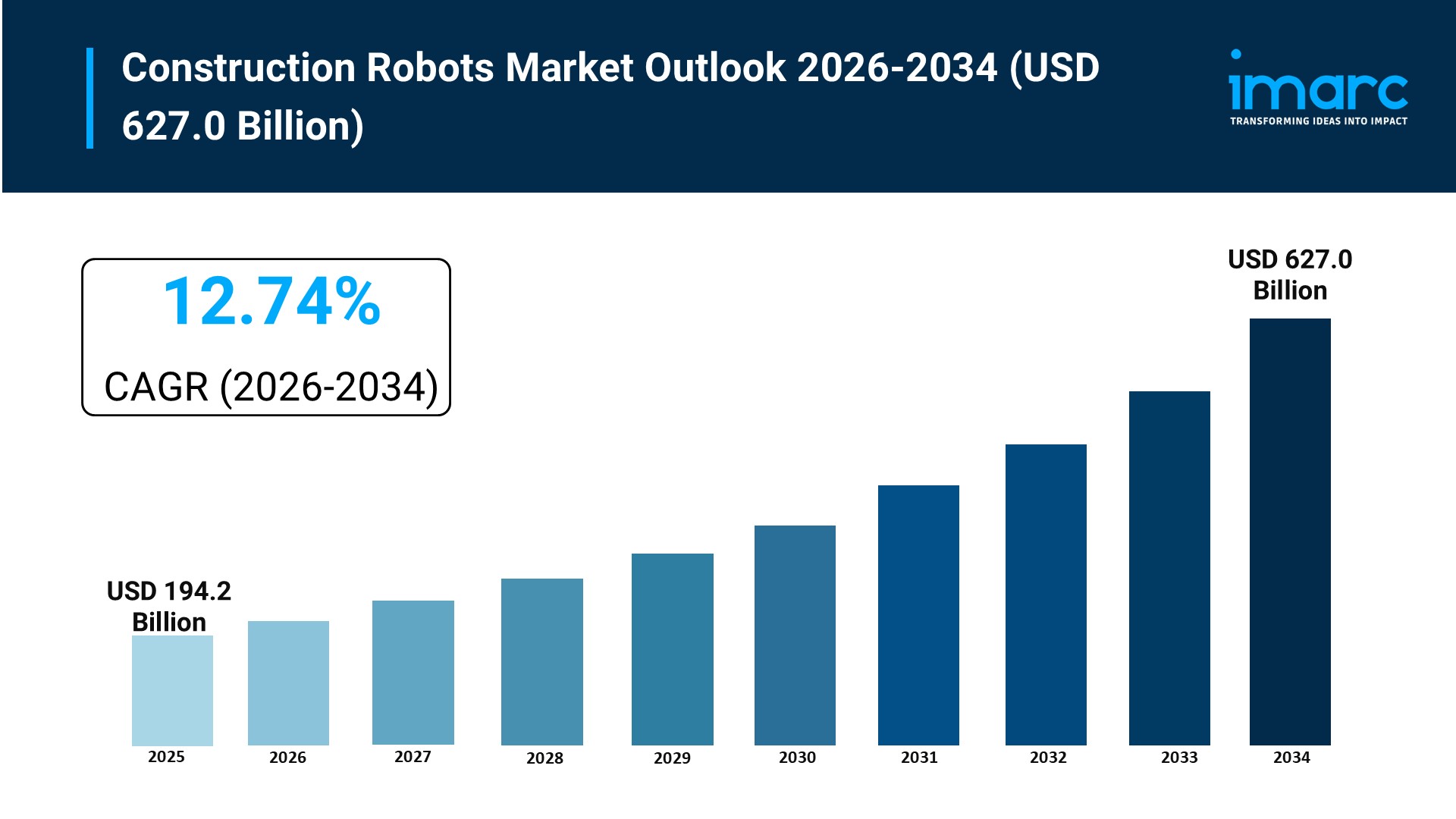
The global construction robots market size reached USD 194.2 Billion in 2025.
SHERIDAN, WY, UNITED STATES, May 11, 2026 /EINPresswire.com/ — The global construction robots market size reached USD 194.2 Billion in 2025 and is projected to grow to USD 627.0 Billion by 2034, expanding at a CAGR of 12.74% during 2026-2034, according to the latest market research report by IMARC Group. Growth is anchored by traditional robots leading the type segment with a 48.6% market share, semi-autonomous systems commanding 57.2% of the automation segment, North America holding the largest regional share at 36.8%, Asia-Pacific emerging as the fastest-growing region, and the accelerating integration of artificial intelligence (AI), machine learning (ML), and the Internet of Things (IoT) across construction platforms globally.
𝐑𝐞𝐩𝐨𝐫𝐭 𝐇𝐢𝐠𝐡𝐥𝐢𝐠𝐡𝐭𝐬
𝐌𝐚𝐫𝐤𝐞𝐭 𝐒𝐢𝐳𝐞 (𝟐𝟎𝟐𝟓): 𝐔𝐒𝐃 𝟏𝟗𝟒.𝟐 𝐁𝐢𝐥𝐥𝐢𝐨𝐧
𝐌𝐚𝐫𝐤𝐞𝐭 𝐅𝐨𝐫𝐞𝐜𝐚𝐬𝐭 (𝟐𝟎𝟑𝟒): 𝐔𝐒𝐃 𝟔𝟐𝟕.𝟎 𝐁𝐢𝐥𝐥𝐢𝐨𝐧
𝐂𝐀𝐆𝐑 (𝟐𝟎𝟐𝟔–𝟐𝟎𝟑𝟒): 1𝟐.74%
𝐋𝐞𝐚𝐝𝐢𝐧𝐠 𝐑𝐞𝐠𝐢𝐨𝐧: 𝐍𝐨𝐫𝐭𝐡 𝐀𝐦𝐞𝐫𝐢𝐜𝐚 (𝟑𝟔.𝟖% 𝐬𝐡𝐚𝐫𝐞)
𝐅𝐚𝐬𝐭𝐞𝐬𝐭-𝐆𝐫𝐨𝐰𝐢𝐧𝐠 𝐑𝐞𝐠𝐢𝐨𝐧: 𝐀𝐬𝐢𝐚-𝐏𝐚𝐜𝐢𝐟𝐢𝐜
𝐋𝐞𝐚𝐝𝐢𝐧𝐠 𝐓𝐲𝐩𝐞: 𝐓𝐫𝐚𝐝𝐢𝐭𝐢𝐨𝐧𝐚𝐥 𝐑𝐨𝐛𝐨𝐭 (𝟒𝟖.𝟔% 𝐬𝐡𝐚𝐫𝐞)
𝐋𝐞𝐚𝐝𝐢𝐧𝐠 𝐀𝐮𝐭𝐨𝐦𝐚𝐭𝐢𝐨𝐧 𝐌𝐨𝐝𝐞: 𝐒𝐞𝐦𝐢-𝐀𝐮𝐭𝐨𝐧𝐨𝐦𝐨𝐮𝐬 (𝟓𝟕.𝟐% 𝐬𝐡𝐚𝐫𝐞)
𝐋𝐞𝐚𝐝𝐢𝐧𝐠 𝐅𝐮𝐧𝐜𝐭𝐢𝐨𝐧: 𝐃𝐞𝐦𝐨𝐥𝐢𝐭𝐢𝐨𝐧
𝐋𝐞𝐚𝐝𝐢𝐧𝐠 𝐀𝐩𝐩𝐥𝐢𝐜𝐚𝐭𝐢𝐨𝐧: 𝐏𝐮𝐛𝐥𝐢𝐜 𝐈𝐧𝐟𝐫𝐚𝐬𝐭𝐫𝐮𝐜𝐭𝐮𝐫𝐞
𝐂𝐨𝐧𝐬𝐭𝐫𝐮𝐜𝐭𝐢𝐨𝐧 𝐑𝐨𝐛𝐨𝐭𝐬 𝐌𝐚𝐫𝐤𝐞𝐭 𝐎𝐮𝐭𝐥𝐨𝐨𝐤
𝐃𝐨𝐰𝐧𝐥𝐨𝐚𝐝 𝐚 𝐅𝐫𝐞𝐞 𝐒𝐚𝐦𝐩𝐥𝐞 𝐂𝐨𝐩𝐲 𝐨𝐟 𝐭𝐡𝐞 𝐑𝐞𝐩𝐨𝐫𝐭: https://www.imarcgroup.com/construction-robots-market/requestsample
𝐂𝐨𝐧𝐬𝐭𝐫𝐮𝐜𝐭𝐢𝐨𝐧 𝐑𝐨𝐛𝐨𝐭𝐬 𝐌𝐚𝐫𝐤𝐞𝐭 𝐎𝐮𝐭𝐥𝐨𝐨𝐤 𝟐𝟎𝟐𝟔–𝟐𝟎𝟑𝟒
Construction robots are automated machines designed to perform tasks traditionally executed by human labor across building and infrastructure projects. These include demolition, bricklaying, 3D printing of structural elements, concrete structural erection, finishing work, and door and window installation. Their deployment enhances efficiency, safety, and precision while reducing labor costs, minimizing project timelines, and lowering the incidence of workplace fatalities on hazardous construction sites.
The market reached USD 194.2 Billion in 2025 and is set for significant expansion through 2034, driven by acute labor shortages, rapid advances in artificial intelligence and robotics, an intensifying regulatory focus on jobsite safety, a rising emphasis on sustainable construction practices, and growing recognition across the industry about the long-term cost-effectiveness of construction robots.
𝐂𝐨𝐧𝐬𝐭𝐫𝐮𝐜𝐭𝐢𝐨𝐧 𝐑𝐨𝐛𝐨𝐭𝐬 𝐌𝐚𝐫𝐤𝐞𝐭 𝐃𝐫𝐢𝐯𝐞𝐫𝐬 𝟐𝟎𝟐𝟔
𝟏. 𝐑𝐢𝐬𝐢𝐧𝐠 𝐋𝐚𝐛𝐨𝐫 𝐒𝐡𝐨𝐫𝐭𝐚𝐠𝐞 𝐚𝐧𝐝 𝐏𝐫𝐨𝐝𝐮𝐜𝐭𝐢𝐯𝐢𝐭𝐲 𝐄𝐧𝐡𝐚𝐧𝐜𝐞𝐦𝐞𝐧𝐭
The rising labor shortages in the construction industry, owing to the physically demanding nature of the work and the fluctuation in demand for construction projects, are providing a strong thrust to the market growth. Robots in construction can mitigate labor shortages by performing repetitive or dangerous tasks, thereby reducing the reliance on human labor. Moreover, they can work continuously without breaks, leading to increased productivity. Additionally, robots can operate in environments that are hazardous or inaccessible to humans, such as high-rise exteriors or toxic environments. The widespread integration of robots into construction for precise and high-quality work, as they perform tasks with greater accuracy and consistency, is further enhancing the market growth.
𝟐. 𝐑𝐚𝐩𝐢𝐝 𝐓𝐞𝐜𝐡𝐧𝐨𝐥𝐨𝐠𝐢𝐜𝐚𝐥 𝐀𝐝𝐯𝐚𝐧𝐜𝐞𝐦𝐞𝐧𝐭𝐬
The rapid advancement in technologies such as artificial intelligence (AI), machine learning (ML), and the Internet of Things (IoT), enabling robots to perform complex tasks with greater autonomy and adaptability, is creating a positive outlook for the market growth. The widespread utilization of AI-powered robots to make real-time decisions based on environmental changes or unforeseen obstacles on construction sites is boosting the market growth. Furthermore, the rising integration of IoT technologies for seamless communication between robots and other digital systems on-site, facilitating coordinated efforts and data sharing, is positively impacting the market growth.
𝟑. 𝐈𝐧𝐜𝐫𝐞𝐚𝐬𝐢𝐧𝐠 𝐂𝐨𝐧𝐜𝐞𝐫𝐧 𝐟𝐨𝐫 𝐒𝐚𝐟𝐞𝐭𝐲
The heightened concern for safety in the construction industry, owing to the high risk of accidents and injuries, is one of the major factors propelling the market growth. The introduction of construction robots that enhance human safety by taking over high-risk tasks such as working at heights, lifting heavy materials, or operating in unstable environments is providing a considerable boost to the market growth. Additionally, robots can be equipped with advanced sensors and safety mechanisms that allow them to detect and avoid obstacles or unsafe conditions, further enhancing on-site safety and reducing the need for safety-related interventions and downtime.
𝟒. 𝐇𝐞𝐢𝐠𝐡𝐭𝐞𝐧𝐞𝐝 𝐃𝐞𝐦𝐚𝐧𝐝 𝐟𝐨𝐫 𝐒𝐮𝐬𝐭𝐚𝐢𝐧𝐚𝐛𝐢𝐥𝐢𝐭𝐲 𝐚𝐧𝐝 𝐄𝐜𝐨-𝐅𝐫𝐢𝐞𝐧𝐝𝐥𝐢𝐧𝐞𝐬𝐬
The escalating focus on environmental sustainability across the globe, prompting the adoption of eco-friendly practices in the construction industry, is favoring the market growth. The widespread utilization of construction robots to ensure precise and efficient use of materials, thereby reducing waste, is acting as a growth-inducing factor. Moreover, the rising adoption of robots equipped with advanced sensors that can measure and cut materials with high accuracy, ensuring minimal excess, is favoring the market growth. The burgeoning demand for energy-efficient robots powered by renewable energy sources, contributing to a lower carbon footprint of construction projects, is providing a considerable boost to the market growth.
𝟓. 𝐆𝐫𝐨𝐰𝐢𝐧𝐠 𝐀𝐰𝐚𝐫𝐞𝐧𝐞𝐬𝐬 𝐀𝐛𝐨𝐮𝐭 𝐂𝐨𝐬𝐭-𝐄𝐟𝐟𝐞𝐜𝐭𝐢𝐯𝐞𝐧𝐞𝐬𝐬
The heightened awareness about the long-term cost savings of construction robots, owing to their ability to speed up construction timelines, reduce labor costs, and minimize errors and material wastage, is strengthening the market growth. The efficiency and precision offered by robots, leading to substantial cost reductions while making projects more economically viable, is offering lucrative growth opportunities for the market. Furthermore, the rising durability and low maintenance requirements of construction robots are fostering the market growth, alongside their ability to operate in environments that are hazardous for humans, mitigating potential delays and liabilities associated with workplace accidents.
𝐒𝐩𝐞𝐚𝐤 𝐃𝐢𝐫𝐞𝐜𝐭𝐥𝐲 𝐰𝐢𝐭𝐡 𝐚𝐧 𝐀𝐧𝐚𝐥𝐲𝐬𝐭 𝐟𝐨𝐫 𝐂𝐮𝐬𝐭𝐨𝐦𝐢𝐳𝐞𝐝 𝐈𝐧𝐬𝐢𝐠𝐡𝐭𝐬: https://www.imarcgroup.com/request?type=report&id=1557&flag=C
𝐂𝐨𝐧𝐬𝐭𝐫𝐮𝐜𝐭𝐢𝐨𝐧 𝐑𝐨𝐛𝐨𝐭𝐬 𝐌𝐚𝐫𝐤𝐞𝐭 𝐓𝐫𝐞𝐧𝐝𝐬 𝟐𝟎𝟐𝟔
𝐒𝐡𝐢𝐟𝐭 𝐓𝐨𝐰𝐚𝐫𝐝 𝐒𝐞𝐦𝐢-𝐀𝐮𝐭𝐨𝐧𝐨𝐦𝐨𝐮𝐬 𝐚𝐧𝐝 𝐅𝐮𝐥𝐥𝐲 𝐀𝐮𝐭𝐨𝐧𝐨𝐦𝐨𝐮𝐬 𝐒𝐲𝐬𝐭𝐞𝐦𝐬
The semi-autonomous segment currently commands 57.2% of the global construction robots market, reflecting the industry’s preference for systems that combine advanced automation with retained human oversight. Semi-autonomous robots operate under partial human control or supervision, offering a practical balance that leverages human expertise for decision-making while automating repetitive or hazardous tasks. They find application in remote-controlled demolitions and semi-autonomous vehicles for material transport and handling. The fully autonomous segment, meanwhile, is gaining traction rapidly, as robots designed to operate without human intervention, relying on advanced sensors, AI, and ML algorithms, prove increasingly effective in repetitive, large-scale tasks such as road construction and bricklaying.
𝐄𝐦𝐞𝐫𝐠𝐞𝐧𝐜𝐞 𝐨𝐟 𝐀𝐞𝐫𝐢𝐚𝐥 𝐑𝐨𝐛𝐨𝐭𝐢𝐜𝐬 𝐚𝐧𝐝 𝐃𝐫𝐨𝐧𝐞𝐬
The emerging popularity of aerial robotics devices such as Unmanned Aerial Vehicles (UAV) or drones, used for safety inspections, site surveying, and accessing hazardous zones, is one of the primary drivers of the global construction robots market. Drones enable project managers to monitor vast construction areas in real time, identify structural inconsistencies, and perform tasks that would otherwise require significant human exposure to risk.
𝐀𝐝𝐯𝐚𝐧𝐜𝐞𝐝 𝐍𝐚𝐯𝐢𝐠𝐚𝐭𝐢𝐨𝐧 𝐒𝐲𝐬𝐭𝐞𝐦𝐬 𝐢𝐧 𝐓𝐫𝐚𝐝𝐢𝐭𝐢𝐨𝐧𝐚𝐥 𝐑𝐨𝐛𝐨𝐭𝐬
Traditional robots, which hold 48.6% of the type segment, continue to evolve through the development of advanced navigation systems that allow them to maneuver effectively within complex construction environments. The rising capability of traditional robots to adapt to various site scenarios is increasing their operational effectiveness across material handling, demolition, and structural assembly applications. The continuous development focus on improving autonomy and operational capabilities is further strengthening this segment’s position in the market.
𝐒𝐭𝐫𝐚𝐭𝐞𝐠𝐢𝐜 𝐏𝐚𝐫𝐭𝐧𝐞𝐫𝐬𝐡𝐢𝐩𝐬 𝐚𝐧𝐝 𝐑&𝐃 𝐈𝐧𝐯𝐞𝐬𝐭𝐦𝐞𝐧𝐭 𝐛𝐲 𝐊𝐞𝐲 𝐏𝐥𝐚𝐲𝐞𝐫𝐬
Key players are engaging in strategic initiatives to strengthen their market positions and respond to the evolving demands of the industry. They are heavily investing in research and development (R&D) to innovate and improve the capabilities of construction robots, with a focus on enhanced AI integration, greater autonomy, and improved safety features. Several companies are forming collaborations and partnerships to combine expertise and resources to accelerate technological advancements and expand their market reach. Many players are also exploring new application areas for construction robots, such as in disaster recovery or complex architectural projects, to broaden their use cases.
𝐂𝐨𝐧𝐬𝐭𝐫𝐮𝐜𝐭𝐢𝐨𝐧 𝐑𝐨𝐛𝐨𝐭𝐬 𝐌𝐚𝐫𝐤𝐞𝐭 𝐒𝐞𝐠𝐦𝐞𝐧𝐭𝐚𝐭𝐢𝐨𝐧
𝐁𝐲 𝐓𝐲𝐩𝐞
• Traditional Robot (48.6% share, leading)
• Robotic Arm
• Exoskeleton
Leading Segment: Traditional robots hold the largest share at 48.6%, employed for a wide range of tasks including material handling, demolition, and structural assembly. Their versatility and capability to perform repetitive, high-volume tasks efficiently make them invaluable on large-scale construction sites.
𝐁𝐲 𝐀𝐮𝐭𝐨𝐦𝐚𝐭𝐢𝐨𝐧
• Semi-Autonomous (57.2% share, leading)
• Fully Autonomous
Leading Segment: Semi-autonomous systems lead with a 57.2% share, operating under partial human control and offering the flexibility to adapt to diverse construction scenarios with minimal programming, making them suitable for a wide range of project types and scales.
𝐁𝐲 𝐅𝐮𝐧𝐜𝐭𝐢𝐨𝐧
• Demolition (leading)
• Bricklaying
• 3D Printing
• Concrete Structural Erection
• Finishing Work
• Doors and Windows
• Others
Leading Segment: Demolition holds the largest functional share, as construction robots are highly valued for their ability to perform dangerous and labor-intensive demolition tasks with precision. Equipped with heavy-duty tools like hydraulic breakers and crushers, they safely demolish structures in controlled manners while minimizing risk to human workers, including in confined spaces where traditional methods are impractical or unsafe.
𝐁𝐲 𝐀𝐩𝐩𝐥𝐢𝐜𝐚𝐭𝐢𝐨𝐧
• Public Infrastructure (leading)
• Commercial and Residential Buildings
• Nuclear Dismantling and Demolition
• Others
Leading Segment: Public infrastructure dominates the application segment, driven by the extensive use of robots in large-scale projects such as bridges, roads, tunnels, and public transit systems, where high precision, durability, and worker safety are paramount requirements.
𝐑𝐞𝐠𝐢𝐨𝐧𝐚𝐥 𝐈𝐧𝐬𝐢𝐠𝐡𝐭𝐬: 𝐂𝐨𝐧𝐬𝐭𝐫𝐮𝐜𝐭𝐢𝐨𝐧 𝐑𝐨𝐛𝐨𝐭𝐬 𝐌𝐚𝐫𝐤𝐞𝐭
𝐍𝐨𝐫𝐭𝐡 𝐀𝐦𝐞𝐫𝐢𝐜𝐚 (𝟑𝟔.𝟖% 𝐬𝐡𝐚𝐫𝐞, 𝐌𝐚𝐫𝐤𝐞𝐭 𝐋𝐞𝐚𝐝𝐞𝐫)
North America leads the global construction robots market with a 36.8% share, driven by advanced technological infrastructure, high labor costs, and a strong focus on safety and efficiency in construction practices. The region’s rapid adoption of innovative technologies including AI and automation, facilitating the integration of robots into various construction processes, is favoring the market growth. North America’s robust economy and substantial investments in public infrastructure and private construction projects are fueling the demand for construction robots. Additionally, the presence of leading companies and startups in the region is accelerating the development and deployment of cutting-edge construction robotics.
𝐀𝐬𝐢𝐚-𝐏𝐚𝐜𝐢𝐟𝐢𝐜 (𝐅𝐚𝐬𝐭𝐞𝐬𝐭-𝐆𝐫𝐨𝐰𝐢𝐧𝐠 𝐑𝐞𝐠𝐢𝐨𝐧)
Asia-Pacific is the fastest-growing segment in the global construction robots market, largely owing to the region’s booming construction industry. Increasing urbanization, coupled with significant infrastructure development initiatives, is creating high demand for construction robots across the region. The growing geriatric population in Asia-Pacific, prompting the need for technological innovation to offset declining labor availability, is further favoring the market growth.
𝐄𝐮𝐫𝐨𝐩𝐞
Europe’s construction robots market is characterized by a strong emphasis on quality, precision, and adherence to strict safety regulations. The region’s advanced technological landscape, along with the implementation of supportive government policies promoting automation and digitalization in construction, is fostering the market growth.
𝐋𝐚𝐭𝐢𝐧 𝐀𝐦𝐞𝐫𝐢𝐜𝐚
Latin America’s construction robots market is emerging, driven by the region’s growing urbanization and the need to modernize infrastructure. The increasing interest in leveraging technology to overcome challenges such as labor shortages and to improve safety standards is providing a thrust to the market growth.
𝐌𝐢𝐝𝐝𝐥𝐞 𝐄𝐚𝐬𝐭 𝐚𝐧𝐝 𝐀𝐟𝐫𝐢𝐜𝐚
The Middle East and Africa region shows significant potential for growth, owing to increasing construction activities and a rising focus on large-scale infrastructure projects and smart city developments. Continuous investment in infrastructure and R&D by major players across the region is favorably impacting the market growth.
𝐕𝐢𝐞𝐰 𝐭𝐡𝐞 𝐅𝐮𝐥𝐥 𝐑𝐞𝐩𝐨𝐫𝐭: https://www.imarcgroup.com/construction-robots-market
𝐊𝐞𝐲 𝐂𝐨𝐦𝐩𝐚𝐧𝐢𝐞𝐬 𝐢𝐧 𝐭𝐡𝐞 𝐂𝐨𝐧𝐬𝐭𝐫𝐮𝐜𝐭𝐢𝐨𝐧 𝐑𝐨𝐛𝐨𝐭𝐬 𝐌𝐚𝐫𝐤𝐞𝐭
Major players profiled in the IMARC Group report include:
• ABB
• Komatsu Ltd.
• Husqvarna Group
• Built Robotics, Inc.
• Boston Dynamics
• Construction Robotics
• Shimizu Corporation
• Yaskawa Electric Corporation
𝐎𝐭𝐡𝐞𝐫 𝐓𝐫𝐞𝐧𝐝𝐢𝐧𝐠 𝐑𝐞𝐩𝐨𝐫𝐭𝐬 𝐁𝐲 𝐈𝐌𝐀𝐑𝐂 𝐆𝐫𝐨𝐮𝐩:
Collaborative Robot Market Research Report
Industrial Robotics Market Research Report
Server Chassis Market Research Report
𝐀𝐮𝐭𝐨 𝐃𝐢𝐦𝐦𝐢𝐧𝐠 𝐌𝐢𝐫𝐫𝐨𝐫 𝐌𝐚𝐫𝐤𝐞𝐭: https://www.imarcgroup.com/auto-dimming-mirror-market
𝐍𝐞𝐱𝐭-𝐆𝐞𝐧𝐞𝐫𝐚𝐭𝐢𝐨𝐧 𝐅𝐢𝐫𝐞𝐰𝐚𝐥𝐥 𝐌𝐚𝐫𝐤𝐞𝐭: https://www.imarcgroup.com/next-generation-firewall-market
𝐊𝐞𝐲 𝐓𝐚𝐤𝐞𝐚𝐰𝐚𝐲𝐬 𝐟𝐫𝐨𝐦 𝐭𝐡𝐞 𝐑𝐞𝐩𝐨𝐫𝐭
• The global construction robots market reached USD 194.2 Billion in 2025 and is projected to reach USD 627.0 Billion by 2034.
• Traditional robots lead the type segment with a 48.6% market share, valued for their versatility across high-volume, large-scale construction tasks.
Semi-autonomous systems lead the automation segment with a 57.2% share, balancing robotic efficiency with human oversight.
• Demolition leads the function segment as the most widely adopted robotic application, driven by safety imperatives in hazardous dismantling environments.
• Public infrastructure dominates the application segment, driven by large-scale bridge, road, tunnel, and transit system construction activity.
North America holds the largest regional share at 36.8%, supported by advanced automation infrastructure and substantial public and private construction investment.
• Asia-Pacific is the fastest-growing regional market, propelled by rapid urbanization, infrastructure development, and a growing geriatric population necessitating technological substitution for declining labor supply.
• Key players are investing heavily in R&D, AI integration, and strategic partnerships to enhance robot autonomy, safety, and application breadth.
The growing popularity of UAVs and drones for safety inspection, site surveying, and hazardous zone access is identified as a primary market driver.
𝐀𝐛𝐨𝐮𝐭 𝐈𝐌𝐀𝐑𝐂 𝐆𝐫𝐨𝐮𝐩
IMARC Group is a leading market research company that offers management strategy and market research worldwide. The company partners with clients across all sectors and regions to identify their highest-value opportunities, address their most critical challenges, and transform their businesses. IMARC’s information products cover major market, scientific, economic, and technological developments for business leaders in pharmaceutical, industrial, and high-technology organizations.
𝐂𝐨𝐧𝐭𝐚𝐜𝐭 𝐔𝐬
IMARC Group
134 N 4th St., Brooklyn, NY 11249, USA
Email: sales@imarcgroup.com
Tel: +1-631-791-1145
Website: www.imarcgroup.com
Elena Anderson
IMARC Services Private Limited
+ +1 201-971-6302
email us here
Legal Disclaimer:
EIN Presswire provides this news content “as is” without warranty of any kind. We do not accept any responsibility or liability
for the accuracy, content, images, videos, licenses, completeness, legality, or reliability of the information contained in this
article. If you have any complaints or copyright issues related to this article, kindly contact the author above.

Media gallery